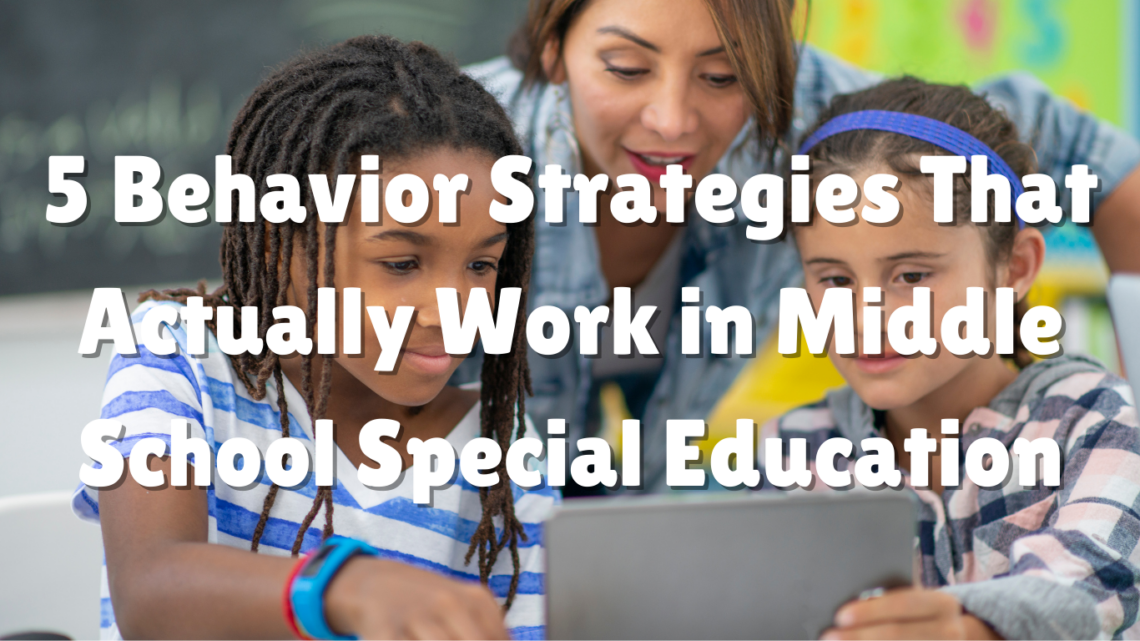
5 Behavior Strategies That Actually Work in Middle School Special Education
Middle school behavior is a special kind of chaos. One minute they’re angels, and the next they’re arguing about who stole whose pencil… that’s in their own hand. Add special education needs, hormones, and a fire drill you didn’t know was happening, and you’ve got yourself a Tuesday.
But good news: there are strategies that actually work reliably, consistently, “I can breathe again” level work. These are the tools I use year after year in my special education classroom because they’re simple, predictable, and don’t require you to become a behavior magician.
Let’s dive into the five strategies that save my sanity (and sometimes my coffee).
1. Clear, Visual Expectations (Because Words Are Overrated)
You can explain the directions beautifully… but if students don’t understand, can’t remember, or just plain don’t want to listen, your words mean nothing.
That’s why visual expectations are my ride-or-die.
Think:
-
“What it looks like / What it doesn’t” posters
-
Step-by-step routines
-
Visual reminders taped to desks
Middle schoolers benefit just as much as elementary kids… they just pretend they don’t. Visuals create consistency, reduce power struggles, and cut down on repeated directions (aka teacher cardio).
2. Silent Signals for the Win
Let’s be honest; middle schoolers love to interrupt at the worst possible times.
Silent signals let students communicate needs without derailing instruction. Some of my favorites:
-
Raised fingers (1 = pencil, 2 = bathroom, 3 = break)
-
Hand on heart for “I need help”
-
Visual cards for nonverbal communicators
Teaching these upfront is key. Once kids master them, transitions are smoother and you get fewer “UM MISS??!!” moments shouted across the room.
Your blood pressure says thank you.
3. Behavior Momentum (Start Small, Win Big)
If you’ve ever tried to get a student to jump into a task that’s hard, boring, or both, you know the struggle. This is why behavior momentum works so well.
Ask students to complete a few easy, quick tasks first:
-
“Write your name.”
-
“Circle the date.”
-
“Highlight two key words.”
Then slide in the challenging task.
It builds confidence, reduces avoidance, and helps students ease into work instead of hitting a wall the second they open their Chromebook.
4. Two-Minute Connections (Relationship Bank Deposits)
Middle schoolers can smell fake relationships like sharks smell blood.
That’s why I spend two minutes a day intentionally connecting with my most challenging students:
-
Chat about their weekend
-
Ask about a favorite game
-
Compliment their shoes
-
Joke with them in the hallway
These small moments, especially early in the year, build trust in a way that rules and consequences simply can’t. And when you have enough “relationship deposits,” redirecting behavior becomes 10x easier.
This strategy alone has saved entire school years.
5. Predictable Breaks (Because Everyone Needs a Reset Button)
Unpredictable behavior often comes from unpredictable regulation. Many SPED students need structured, consistent breaks to stay in control.
The key: schedule them.
Options that work wonders:
-
5-minute movement break
-
Calm corner timer
-
Weighted tools or fidgets
-
Headphone-quiet time
When breaks are predictable, students don’t demand them, negotiate them, or try to create chaos just to get one.
Bonus: You’ll finally stop saying “This is not the time for a break!” 47 times a day.
Final Thoughts: You Don’t Need Fancy, You Need Functional
Behavior in middle school doesn’t have to feel like riding a roller coaster blindfolded. With simple, tried-and-true strategies, you can create a classroom that is:
-
structured
-
supportive
-
predictable
-
and way less chaotic
Pick one or two strategies to start. Keep it consistent. And celebrate the small wins — because in middle school, the small wins are always the big ones.
FREE co-teaching checklist

Subscribe to receive a free co-teaching checklist!